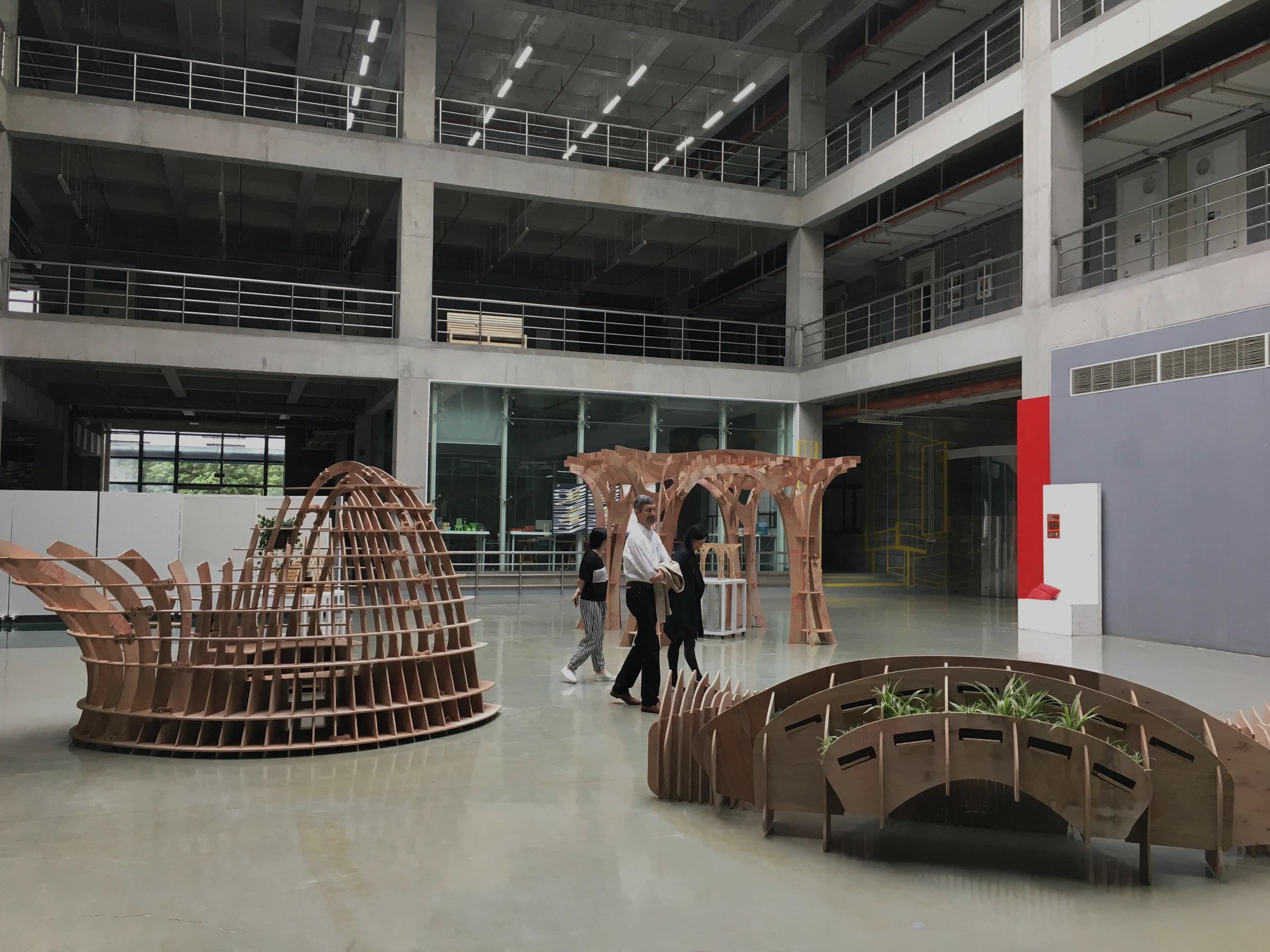
A documented student woven-surface model connects geometric rules to a fabricated result; the archive represents several seminar offerings. View evidence ↓
These seminars introduce parametric design and computational geometry through Rhino and Grasshopper, with additional modeling work in SolidWorks and Maya. Exercises address rule-based design, data organization, geometric transformation, generative modeling, and form finding.
Students develop parametric models and fabricate physical prototypes to test the relationship between geometric decisions and production constraints. Iteration between digital models and physical results connects computational reasoning with material behavior.
Method
Introductory computational exercises connect geometric transformations and data organization with physical fabrication. Students compare the model’s rules with the behavior of the produced object.
- 01
Describe
Identify a geometric rule, transformation, or organizing relationship.
- 02
Construct
Develop a parametric model in Rhino and Grasshopper.
- 03
Make
Fabricate a physical prototype from the model.
- 04
Revise
Use the physical result to reconsider geometric decisions and production constraints.
Geometry and fabrication study
Student study connecting a woven surface geometry with physical model making.
Evidence & scope
The student example pairs a woven-surface geometry with a fabricated model. The source combines several seminar offerings; the archive year is retained without assigning undocumented dates or institutions to individual exercises.