A PLA shell loading demonstration and two thermal-deformation experiments support distinct model-scale claims; architectural canopy images are proposals. View evidence ↓
Developed as part of my Master of Science thesis at Cornell University, this research asks how the geometry and behavior of individual cells can organize an architectural surface. It connects three modes of design: computational generation, physical construction and material transformation. Scutoid Brick investigates how cellular contacts become interlocking shell joints; Programmable Surface Geometry tests how local deformation and overall curvature influence each other, then connects physical shaping to digital modeling. The two studies were published at eCAADe in 2020 and 2021. Both papers and the master’s thesis are linked below.
Cell geometry: the local–global relationship
A curved epithelial tissue must accommodate different packing arrangements across its thickness. Cells can have different neighbors on their apical and basal faces; an edge on one face terminates at an intermediate vertex, creating the triangular contact associated with a scutoid. The research translates this relationship between cellular contact and tissue curvature into rules for surface design.
A four-cell parametric model connects three layers: apical, intermediate and basal. Moving paired vertices changes the length of shared boundaries and the size of triangular contacts. Rotation and compression of neighboring cells relate these local changes to the bending of the cluster. The model makes both directions of the relationship accessible to design: an imposed surface curvature changes its constituent cells, while changes to the cells can generate surface curvature.
Biological reference: cell packing and the scutoid geometry. Source: Gómez-Gálvez et al., 2018.
Three-layer construction of a four-cell cluster (left); variations in cell geometry and shared boundaries (right).
Computational studies: local cell rearrangement (left) and the deformation of cellular surface networks (right).
Scutoid Brick · 2020
The masonry study uses triangular cell contacts as geometric joints between discrete shell units. Its design problem is to subdivide a curved surface into blocks that connect across the shell thickness and constrain relative sliding. Two computational methods explore different relationships between irregular cellular packing and repeatable fabrication rules.
Two methods for generating shell units
Voronoi-based generation. A selection algorithm groups eligible neighboring polygons into four-cell clusters. A C# component in Grasshopper represents the surface as a network of nodes and spring-like edges, with boundary cells fixed. As the network bends, a geometric trigger introduces intermediate vertices and scutoid connections where edges become overextended. This method explores how changes in overall form reorganize local topology.
Rational subdivision. A second generator starts from a prescribed doubly curved shell and constructs related subdivisions on three layers. Hexagons on the outer layer connect through intermediate diamond-shaped profiles to diamonds or octagons on the inner layer. Merging and reconnecting selected vertices produces two complementary brick families, making the subdivision more directly usable for fabrication and assembly.
Voronoi cluster selection (left) and the Grasshopper generation workflow (right), eCAADe 2020, Figures 10–11.
Rational three-layer subdivision (left); complementary units assembled into crossing arch-like sequences (right).
Interlocking, fabrication and model testing
Each brick family has triangular connections aligned with one of the shell’s two surface directions. Successive units form arch-like sequences that intersect and interlock, linking local joint geometry to the organization of the whole shell.
The PLA prototype was printed as discrete units at 20% infill and assembled for a loading demonstration. The 2020 paper reports a model weight of 1.8 lb (0.82 kg) and a supported load of two 40 lb dumbbells, approximately 36 kg in total. An ANSYS study also compared deformation and equivalent stress in the selected shell models. These are prototype-scale investigations; full-scale material, joint and structural testing remained future work.
The assembled PLA shell (left) and the model-scale loading demonstration (right).
Architectural application
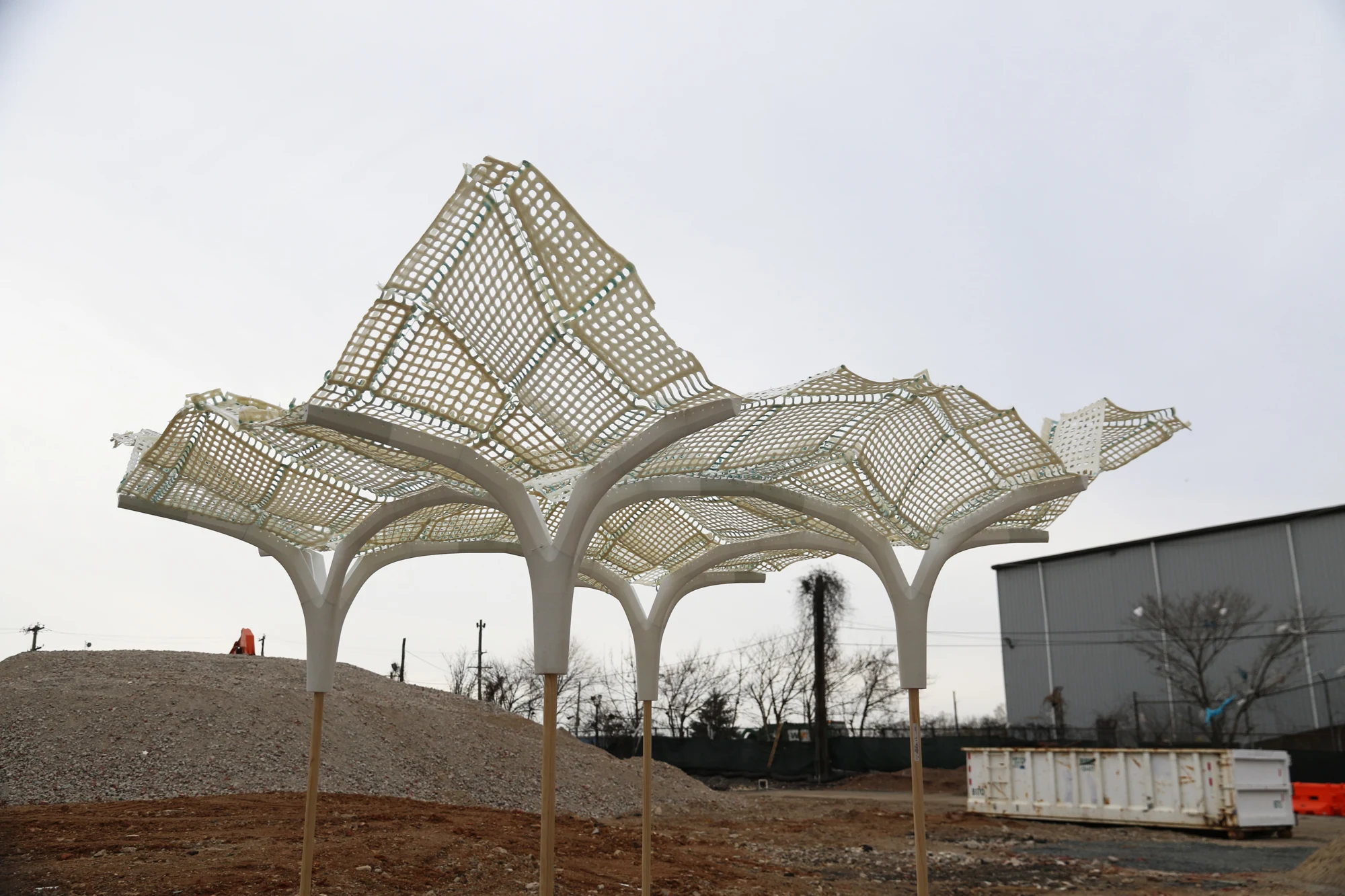
The pavilion studies apply the cellular subdivision to a canopy, using the thickness and continuity of the interlocking units to shape its enclosure. The views below are architectural design visualizations; the built research artifact is the printed shell model shown above.
Shell assembly visualization (left) and an architectural material-detail rendering (right).
Architectural-scale canopy studies in autumn (left) and snow (right).
The uploaded architectural walkthrough (left) and the original Scutoid Brick project film (right).
Programmable Surface Geometry · 2021
The second study makes the cell–surface relationship physically changeable. It develops a material design medium whose shape is driven by thermal response, with no electric actuator required for deformation. Geometry, material assignment and thermal programming determine whether shape change begins in the surrounding frame or in the individual cells.
Two materials divide the active and passive roles: 3D-printed shape-memory polymer (SMP) provides the programmed response, while cast silicone provides compliance. Heating allows the polymer to be reshaped and programmed; cooling fixes the temporary configuration, and subsequent heating activates its shape response. Silicone components are cast in PLA molds.
The constraint frame is essential to both experiments. It keeps cells densely packed so that a change in one component is transmitted to its neighbors. The cell units and frame provide physical analogues of cell expansion and adhesion, translating the biological packing constraints into an assembly that can be fabricated and manipulated.
Constraint geometry in flat and curved states, followed by two-cell and four-cell physical prototypes.
Experiment 1 · Global curvature changes local cells
A programmed SMP frame surrounds passive silicone cells. When the frame bends under heating, it rotates and compresses adjacent cells, changing their shared boundary lengths and generating scutoid-like profiles. The experiment tests whether an imposed change in the assembly’s curvature produces the predicted local morphology.
Cast silicone cell types (left) and the cells packed inside an active SMP constraint frame (right), eCAADe 2021, Figures 4–5.
Frame-driven deformation of two silicone cells (left) and a larger array (right), eCAADe 2021, Figures 6–7.
Experiment 2 · Local cells generate global curvature
Reversing the material assignment makes the cells active. Individually programmed SMP units sit inside a passive silicone frame. Heating changes the units’ shared boundaries and triangular contacts, forcing the assembly to bend as the frame accommodates their motion. Experiments demonstrate bending toward both the apical and basal sides.
The unit construction, frame and assembled array below belong to this deformable surface study. The before-and-after photographs record changes in cell openings and contacts as the material assembly changes curvature.
The relationship between local cell units and the array (left); the active SMP cell geometry (right).
Passive silicone constraint frame (left) and the cell array with its frame (right).
Before-and-after close-ups of the deformable prototype: changes in shared boundaries (left) and cell morphology across the array (right).
Active-cell experiments at two scales and in opposite bending directions (left, eCAADe 2021, Figure 8); close-up of the printed cellular prototype (right).
Thermal deformation experiments: frame-driven silicone cells (left), cell-driven surface bending (center), and an additional cell-array deformation sequence (right).
Tangible interface · From physical shaping to digital geometry
A flex sensor attached to the assembly converts bending into a change in electrical resistance. An Arduino reads that change and transmits curvature data to Rhino and Grasshopper, where the corresponding digital geometry updates during physical manipulation.
The designer can therefore work through two connected operations: programming a material configuration and manually shaping a sensed prototype. Thermal actuation changes the physical geometry; sensing carries the designer’s manipulation back into the digital model. This interface extends the thesis’s interactive design–fabrication approach by using a material assembly as an input to surface design.
The cell assembly and flex sensor at rest (left), manual bending (center), and the resulting digital model update (right).
Related publications
All publications →-
eCAADe 2020 · Interlocking shells
Scutoid Brick - The Designing of Epithelial Cell Inspired-brick in Masonry Shell System
Anthropologic: Architecture and Fabrication in the Cognitive Age - Proceedings of the 38th eCAADe Conference - Volume 1 · 2020
-
eCAADe 2021 · Programmable surfaces
The Design and 4D Printing of Epithelial Cell-Inspired Programmable Surface Geometry
Towards a New, Configurable Architecture: Proceedings of the 39th International Conference of Education and Research in Computer Aided Architectural Design in Europe (eCAADe 2021) · 2021
-
Cornell University · Master of Science thesis
Interactive Fabrication and Design of Bioinspired Surface Geometry
Cornell University · 2021