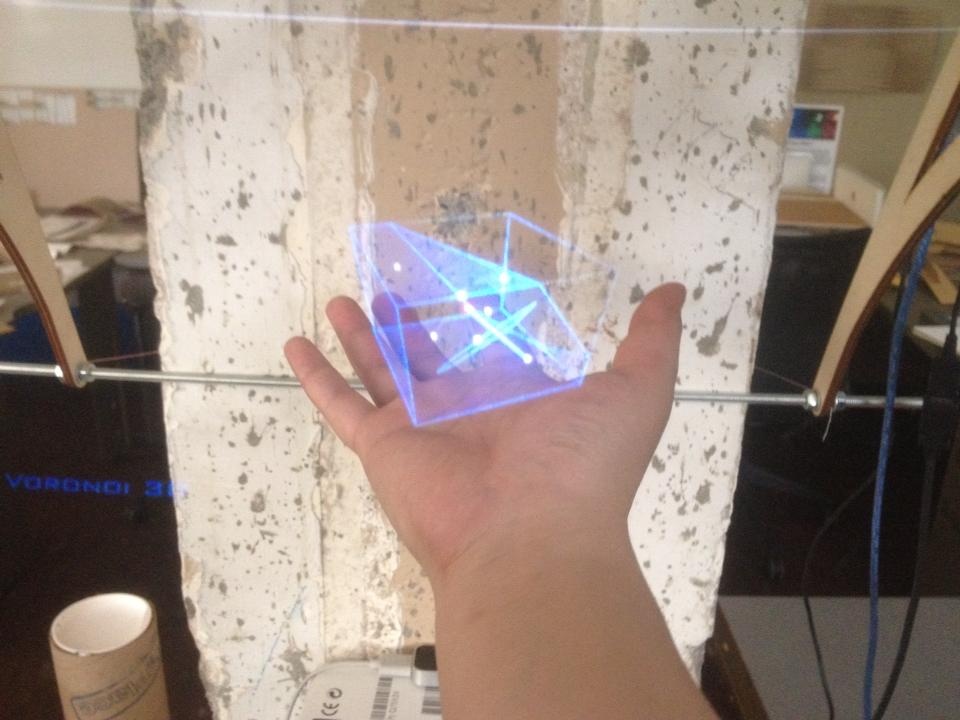
Working prototypes and video demonstrate tracked movement, deformation, and projected shadow and wind-field feedback. View evidence ↓
CuBe is a tangible toolkit for architectural massing studies. I led its development at the University of Washington’s Design Machine Group. Designers move, rotate, twist, and stretch physical models while the system tracks their position or deformation and updates digital geometry. The prototypes give the hands a physical reference and bring building information and environmental visualizations into the working space. The work was published in Transformable Physical Design Media at eCAADe 2015.
CuBe in use
Prototype demonstration: physical manipulation and projected feedback share one working surface.
A tracked tabletop
A camera beneath the translucent tabletop reads markers attached to the models. reacTIVision and Processing pass position and orientation data through UDP to Grasshopper; a projector returns visual information to the table. This arrangement lets designers move physical objects while maintaining their digital representation.
From fixed blocks to changing geometry
The first toolkit uses fixed cube, keystone, and tapered forms to study placement and orientation. A second toolkit adds a twisting, height-adjustable block: rotational and sliding potentiometers measure its deformation and drive a matching digital model.
Tangible model families
Fixed massing objects and a deformable twisting block. Figures 10–11 from Transformable Physical Design Media, eCAADe 2015.
Reconstructing a deformable frame
A third prototype uses ten adjustable members, including two diagonals, and four fixed members. Sliding potentiometers measure member lengths; a microcontroller supplies the data for trigonometric reconstruction of the geometry. Lengthening or shortening the frame changes the proportions of the corresponding digital model.
Feedback during massing studies
Building height, floor count, and area remain associated with the objects as they move. Shadow studies respond to model position, sun position, and deformation of the twisting block. A projected wind-vector field updates with changes in the arrangement of the models, making the effect of a design move visible on the work surface.
Shadow studies
Wind-field feedback
Shared physical and digital design
The deformable frame also supports discussion around a physical model while retaining a digital record of its geometry. The 2015 paper presents CuBe alongside InSpire, connecting tangible manipulation and gesture-based modeling within the same investigation of physical design media.
Related publications
All publications →-
Transformable Physical Design Media
Real Time - Proceedings of the 33rd eCAADe Conference - Volume 1 · 2015
-
Transformable Physical Design Media
University of Washington · 2015