Hinge calibration, transformation videos, and a meter-scale canopy show the forming and assembly process; environmental load capacity remains unquantified. View evidence ↓
Suspended forming at meter scale
Wet agarose adds weight and rehydrates the passive lattice at the hinges. At meter scale, early bending on the printbed concentrates stress along these softened regions and can tear the scaffold before its shape locks.
Suspended forming uses gravity as a controlled boundary condition. Rope positions and lengths establish an intermediate curved geometry and redistribute self-weight during drying. Agarose contraction then refines the fold rotations. Module B retains developable curvature, while Module C forms an anticlastic surface through tuck activation.
Suspended forming and canopy assembly
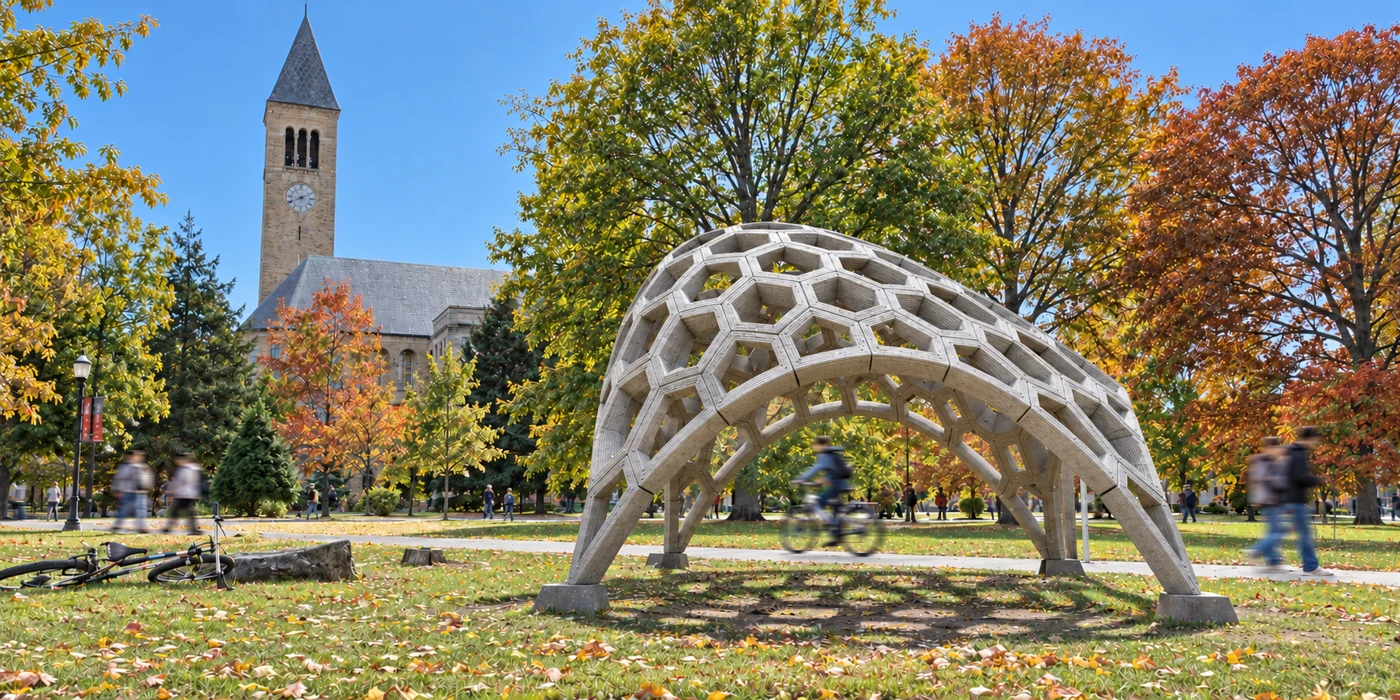
Pavilion assembly and time-lapse sequences of suspended modules developing curvature.
A module damaged during flat-bed actuation (left) and the flat-to-curved transformation of Module C (right).
This project uses multi-material additive manufacturing to achieve 4D printing at pavilion scale. Spatially patterned active and passive materials program how a flat-printed lattice changes shape over time during drying. Localized agarose hinges generate the contraction that transforms the planar modules into a curved canopy.
Scaling this programmed transformation to architectural components requires control of self-weight and temporary material softening. The fabrication sequence coordinates passive-first drying, active-hinge deposition, and suspended forming so the modules develop and retain their target curvature.
The assembled pavilion and the connection between the self-morphed lattice canopy and a branching support.
Force-informed geometry and flat patterns
Polyhedral 3D graphic statics defines a funicular canopy around four supports. The curved network is divided into three module families whose shared boundaries preserve alignment during assembly. Modules A and B use developable curved folding. The saddle-shaped Module C uses tuck folds, inserting local fold regions into a planar pattern to produce anticlastic curvature.
Reciprocal force and form diagrams (left) and the tuck-folding geometry of the saddle module (right).
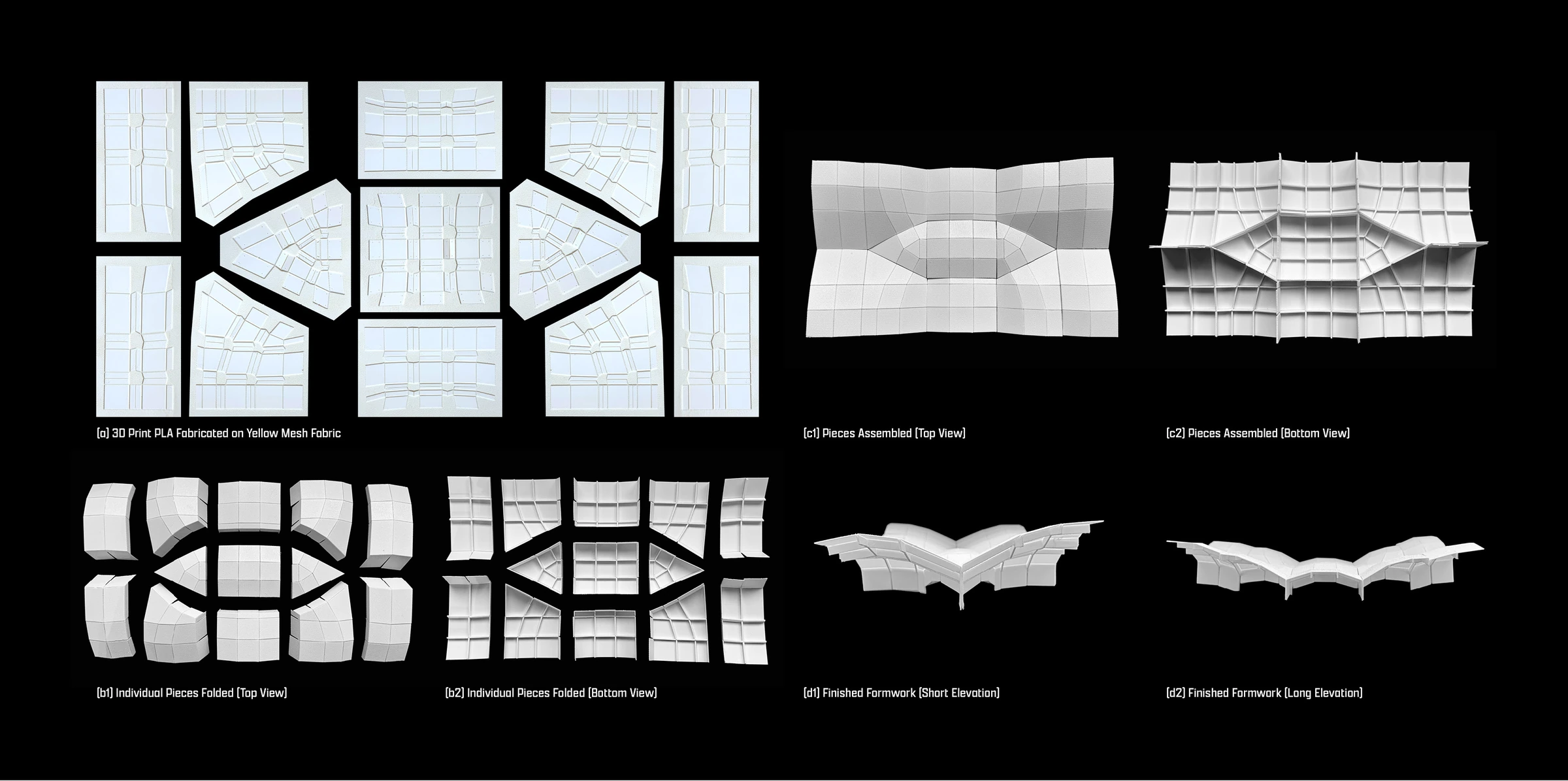
The canopy is divided into three module families and translated into flat printing patterns.
Mapped active hinge regions across the flat module set.
Multi-material printing as a 4D-printing mechanism
Multi-material printing places a drying-responsive agarose layer at selected hinge regions within a passive cellulose–chitosan–fibroin lattice. The bonded materials develop different shrinkage strains: agarose contracts as it loses water, while the dried lattice restrains that contraction and converts it into bending. Printing active material on different faces controls fold direction. This spatial material arrangement encodes the module’s transformation over time, making post-printing shape change the fourth dimension of the fabrication process.
The early PLA/agarose studies establish the bending mechanism. The later bio-based lattice studies coordinate multiple hinges into connected folding patterns.
Bending and fold formation
Early PLA/agarose bending studies (left); fold formation and physical handling of a lattice (right).
Calibrating hinge rotation
Hinge length converts local bilayer curvature into fold rotation. With 2 mm passive and 2 mm active layers, the study compares 18, 32, and 50 mm active regions. The 50 mm hinge develops the fold depth used in the pavilion modules. Separate thickness tests show how the balance between active contraction and passive restraint changes bending.
The 18 mm hinge reaches partial rotation (left); the 50 mm hinge produces deeper closure under the same layer thicknesses (right).
Lattice transformation and hinge thickness
Active/passive lattice transformation (left). Time-lapse comparison of samples with different active-layer thicknesses (right).
Robotic printing and material placement
An ABB IRB 6640 prints the passive lattice on a flat heated bed. Toolpaths maintain continuity through the cellular network to reduce extrusion starts and stops. The pavilion uses approximately 25 mm cells, 6 mm beads, and a 120 mm/s tool speed, with individual prints reaching approximately 2.3 m in plan span.
The passive lattice dries before agarose deposition so the active hinges contract against a stabilized scaffold. Mapped hinge regions are printed on one face, then the module is flipped for deposition on the opposite face where the fold direction requires it.
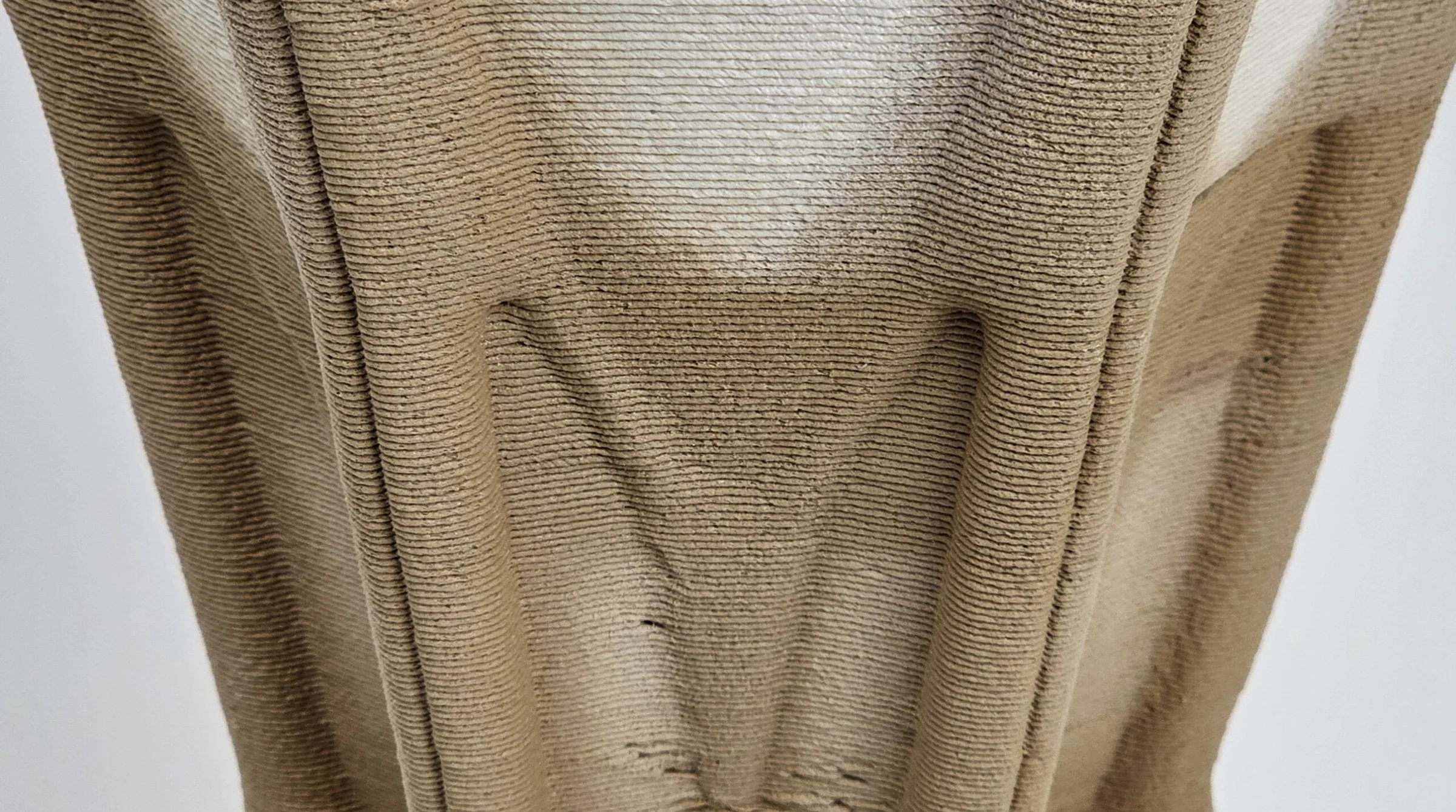
Robotic flat printing (left) and a dried passive lattice at architectural scale (right).
Thermal view of active-material extrusion
Infrared footage documents the heated extrusion process used in the active-material experiments.
Assembly and structural scope
The formed modules are registered on a temporary frame and joined progressively with zip ties through their boundary lattices. Assembly takes approximately 13 hours. Closing the module network allows the frame to be removed and the canopy to transfer to its four supports.
The pavilion demonstrates a mold-free fabrication and assembly route for curved canopy modules. Drying and assembly still require temporary support; joint stiffness, long-term creep, and capacity under environmental loads remain to be quantified.
Related publications
All publications →-
3D-Printed Multi-Material Deployable Structures: Programmable Shape Transformation through Additive Manufacturing
Proceedings of IASS-IWSS 2026: R-Evolution of Shapes: Sustainability, Re-Use, and New Design Paradigms · 2026