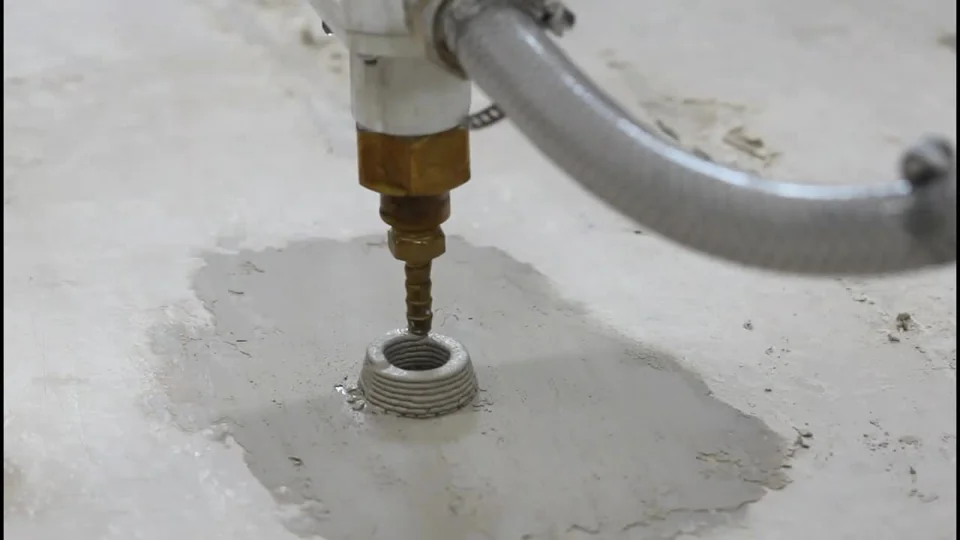
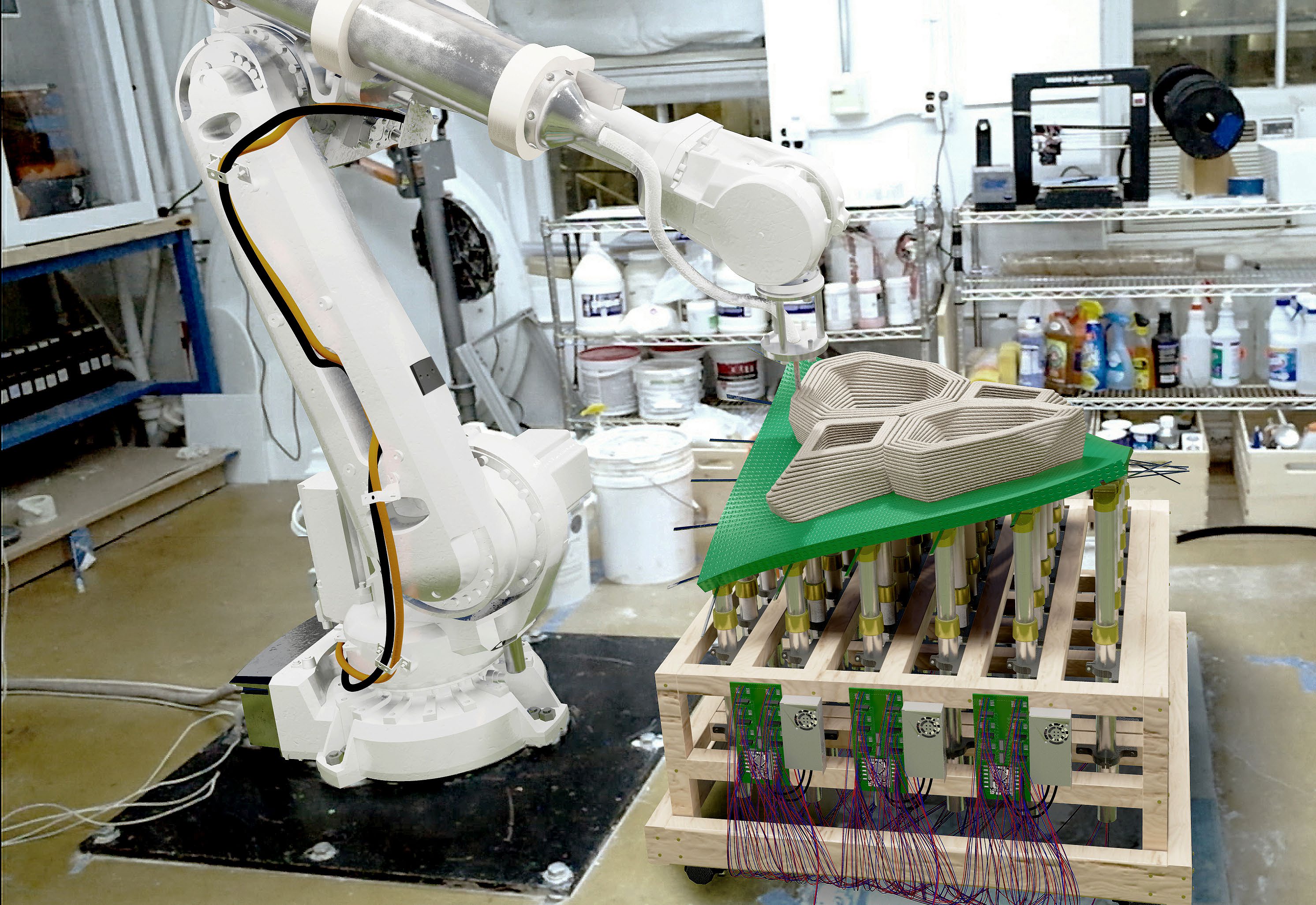
The assembled printer, component drawings, toolpath studies, and printing film document the prototype and its branching-form test. View evidence ↓
Developed in 2022, this project combines a low-cost desktop printer conversion with a custom design-to-fabrication workflow. The aim is to make paste printing more accessible while extending what a three-axis machine can produce.
Hardware and toolpath design are developed together. A separate material feeder supplies an auger nozzle, while branch-oriented slicing, nozzle-clearance adjustments, and adaptive extrusion coordinate the deposition of clay. A multi-branched test form demonstrates the resulting process without support material or internal infill.
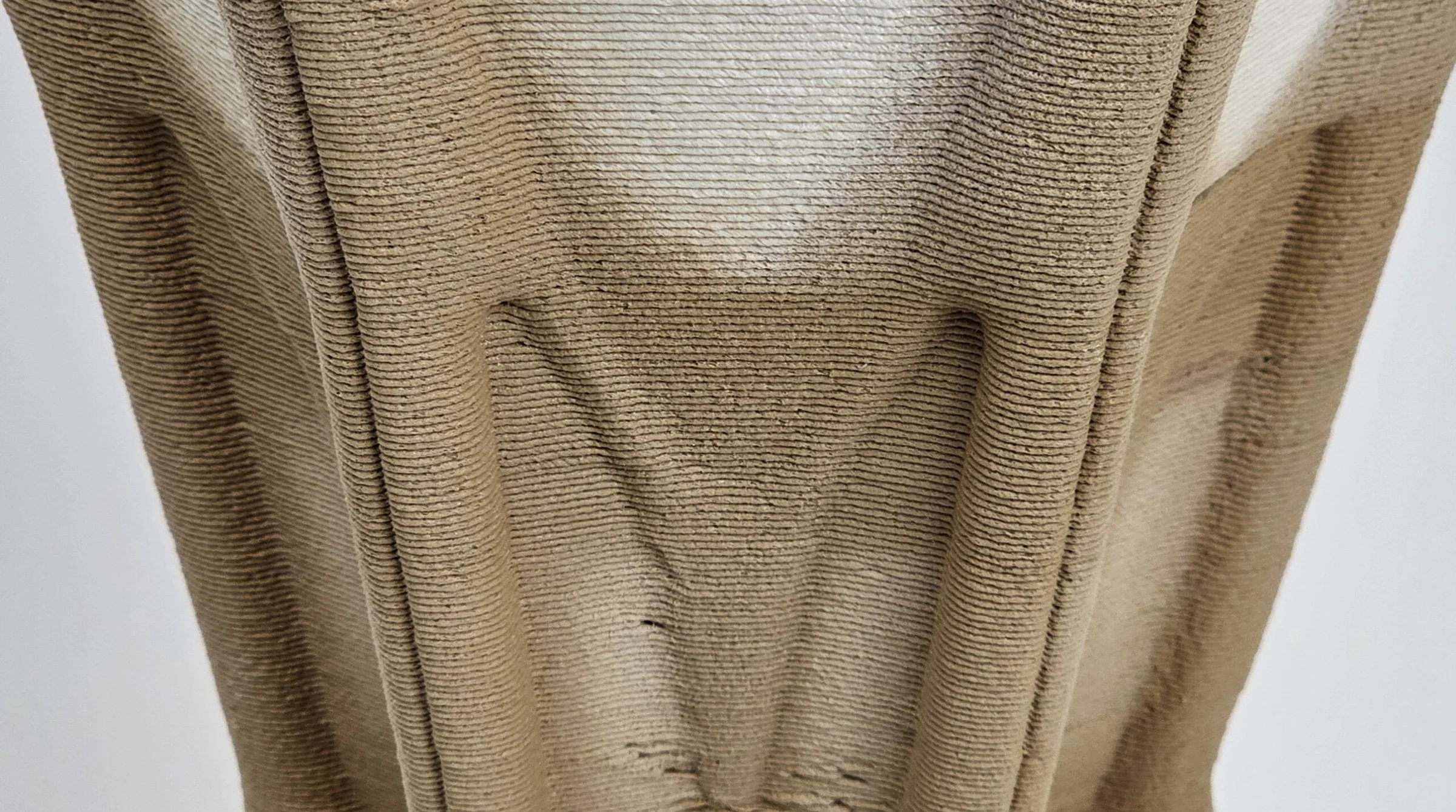
Printing a branching form
The printing film follows the branching geometry as it develops. The close-up shows deposition across changing layer orientations.
A two-stage extrusion system
A geared motor drives a syringe-based material feeder, sending paste through a flexible hose to a compact auger nozzle. Separating storage from the moving printhead reduces the mass carried by the gantry; the auger controls material delivery at the nozzle.
The Ender-3 conversion uses printed polycarbonate components, a detachable nozzle mount, a taller vertical frame, and a replacement control board with external motor drivers. The prototype’s documented 2022 parts budget was approximately US$596, including the base printer. Components were purchased commercially and assembled without custom metal-shop fabrication.
Feeder and auger nozzle
Dimensions, exploded assemblies, and assembled configurations of the two extrusion stages.
Reinforcement and printer integration
Printing direction, reinforcing fasteners, piston restraint, and the detachable mount coordinate the custom hardware with the desktop gantry.
Toolpaths follow the branches
In Rhino/Grasshopper, the model’s branch centerlines guide the orientation of slicing planes. Toolpaths from the individual branches are merged into a sequence that changes height continuously, allowing the three-axis machine to deposit along nonplanar layers.
The workflow distinguishes planar, intersecting, and transition regions. Local nozzle-clearance adjustments reduce collisions with previously deposited material. An adaptive extrusion rate responds to changing distances between adjacent paths, maintaining material delivery where the layer spacing varies.
Geometry, clearance, and extrusion
Branch-oriented slicing generates the paths; clearance and extrusion adjustments address intersections and changing layer spacing.