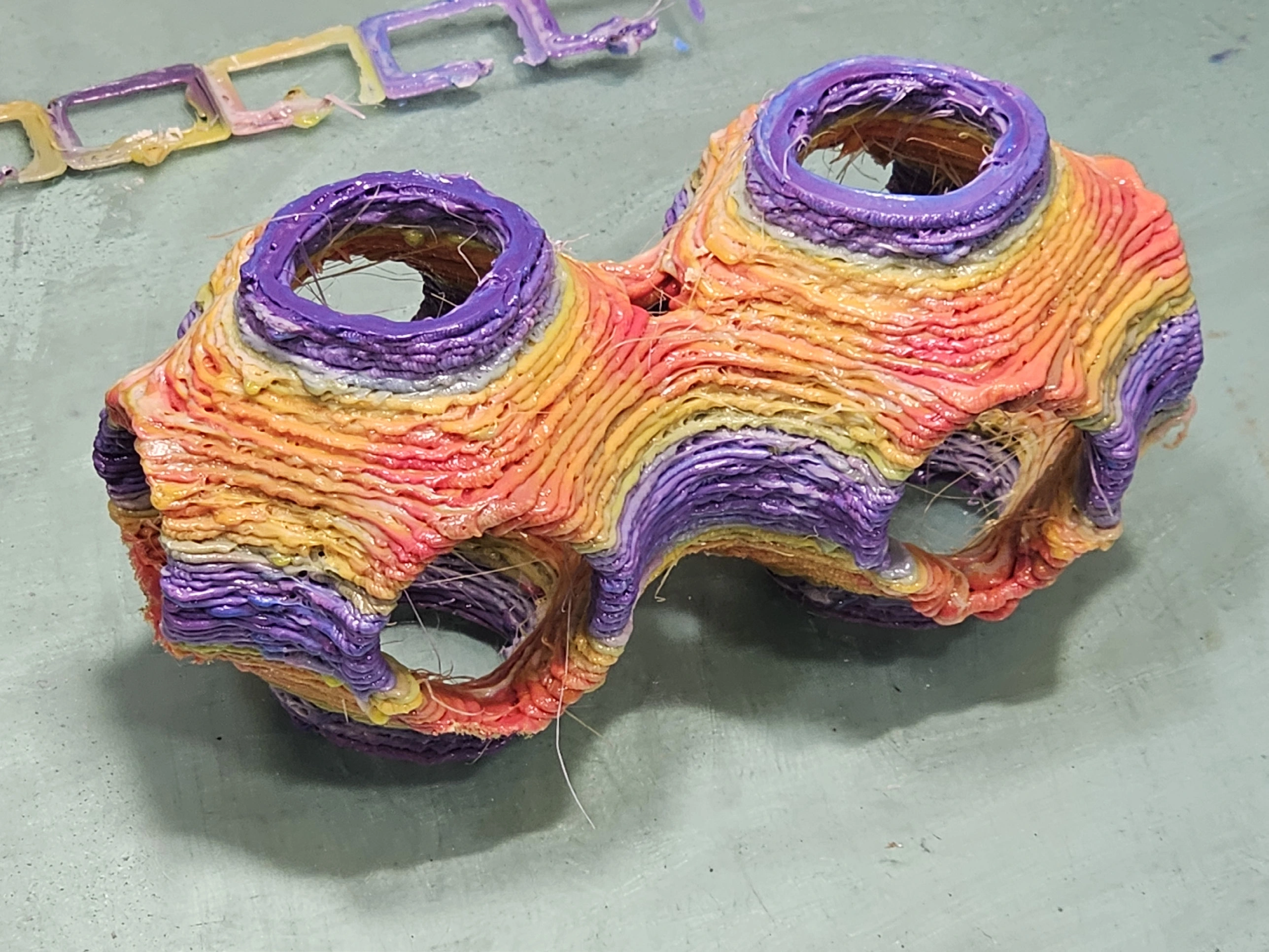
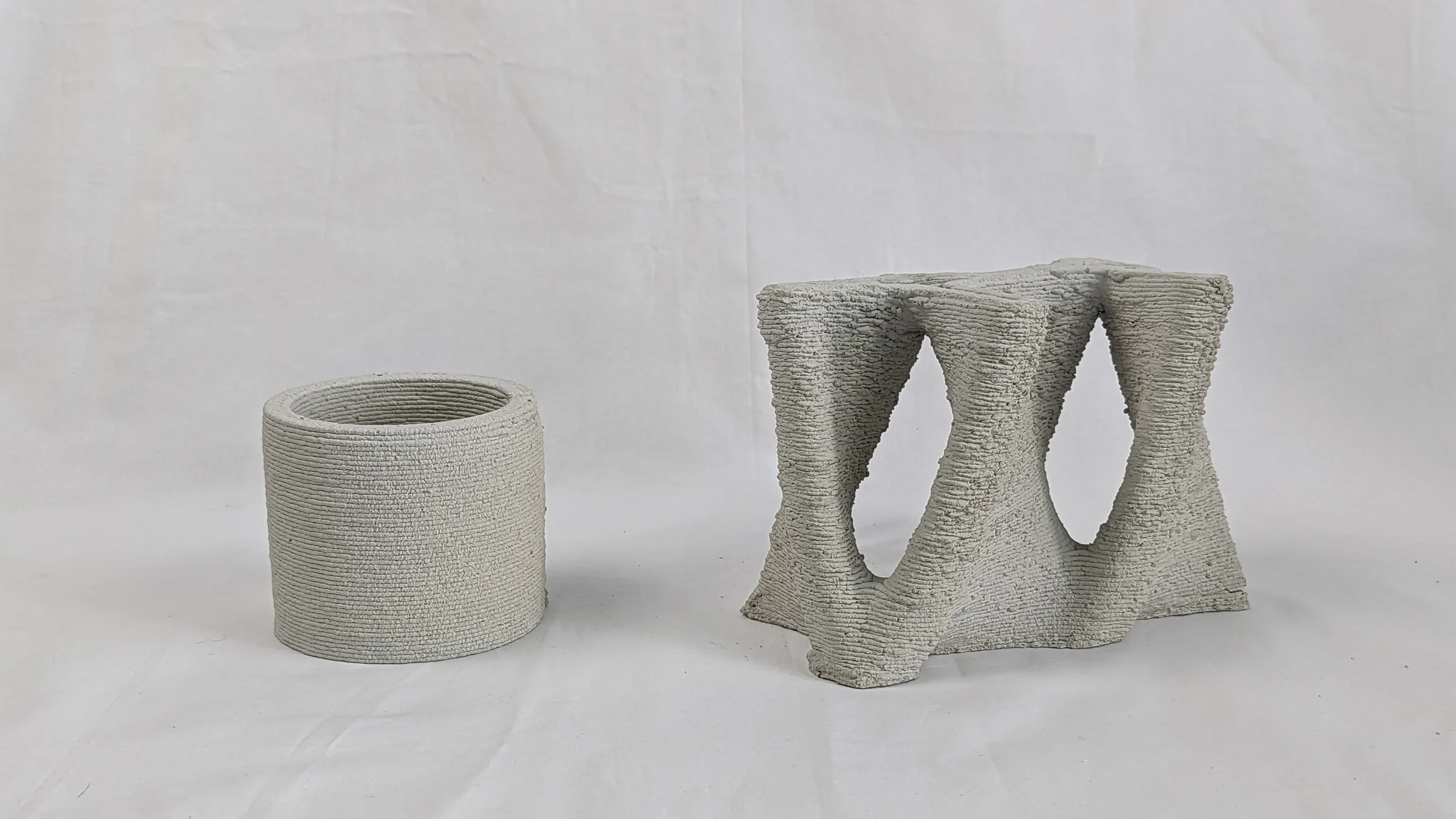
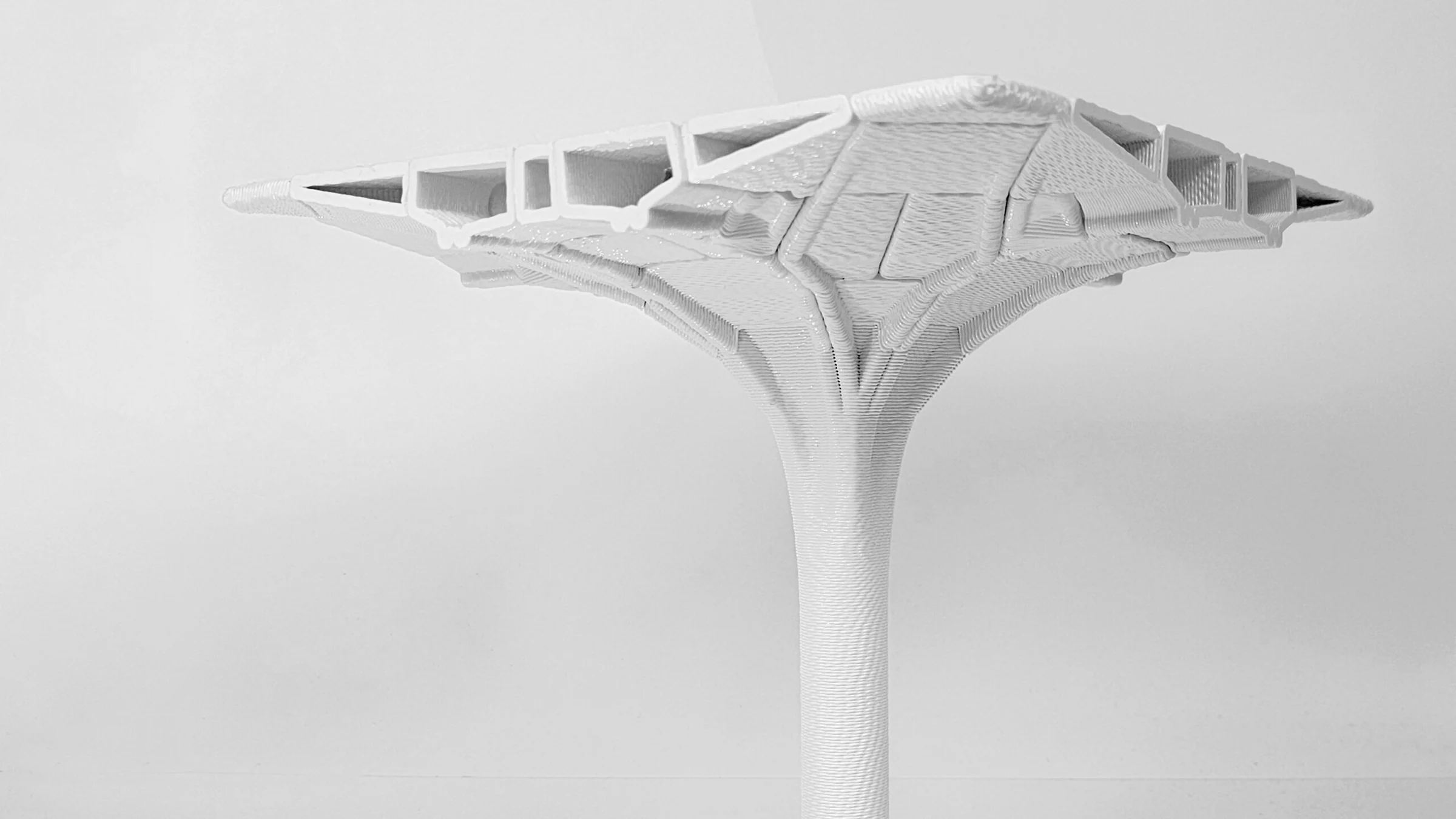
Printed specimens and Ovenbird toolpath studies document continuity, overhang assessment, and deposition planning across component geometries. View evidence ↓
This research automates toolpath design for 3D-printed concrete structural components. Hierarchical geometric data structures and graph algorithms connect the topology of a component to its printing sequence.
Overhang analysis provides criteria for assessing buildability and locating potential failures. Offsetting and filleting methods adjust the path to improve dimensional accuracy and manage overfill at changes in direction.
For branching and porous geometries, the workflow minimizes interruptions by generating paths with as few starts and stops as their topology permits. The resulting paths can also be converted into meshes that represent layer textures or support finite element analysis.
The methods are implemented in Ovenbird, a Grasshopper plug-in for Rhino. Printed specimens test the workflow across different component geometries. I contributed as a coauthor alongside Yefan Zhi, Hua Chai, and Masoud Akbarzadeh.
Printed components
Fabricated components demonstrate different surface geometries, openings, and branching conditions.
Toolpath design workflow
Geometric data structures, processing stages, and fabrication examples.
Buildability and continuous deposition
Overhang evaluation, path adjustment, seam reduction, and toolpath visualization.
Related publications
All publications →-
Automated Toolpath Design of 3D Concrete Printing Structural Components
Additive Manufacturing · 2025