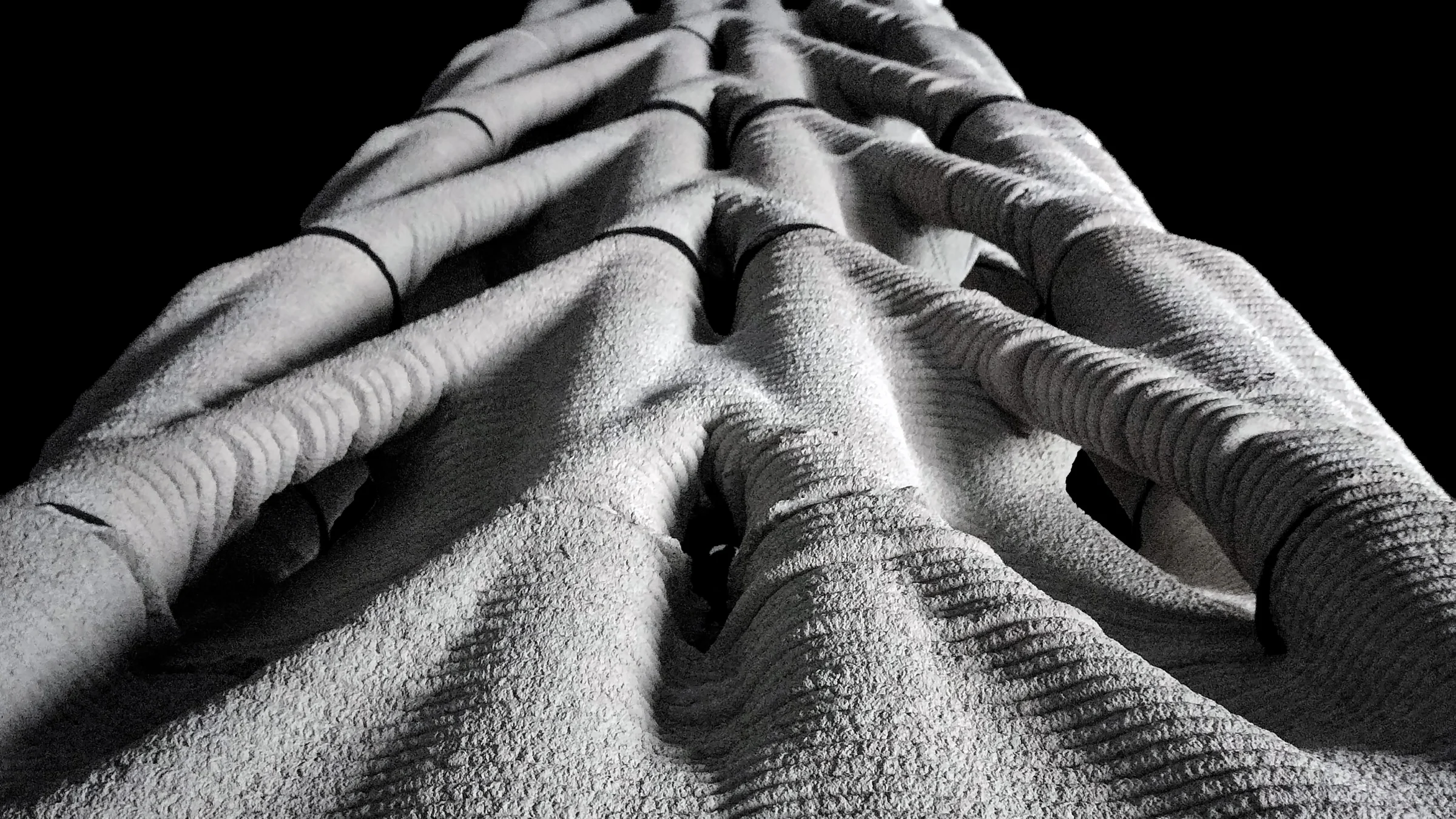
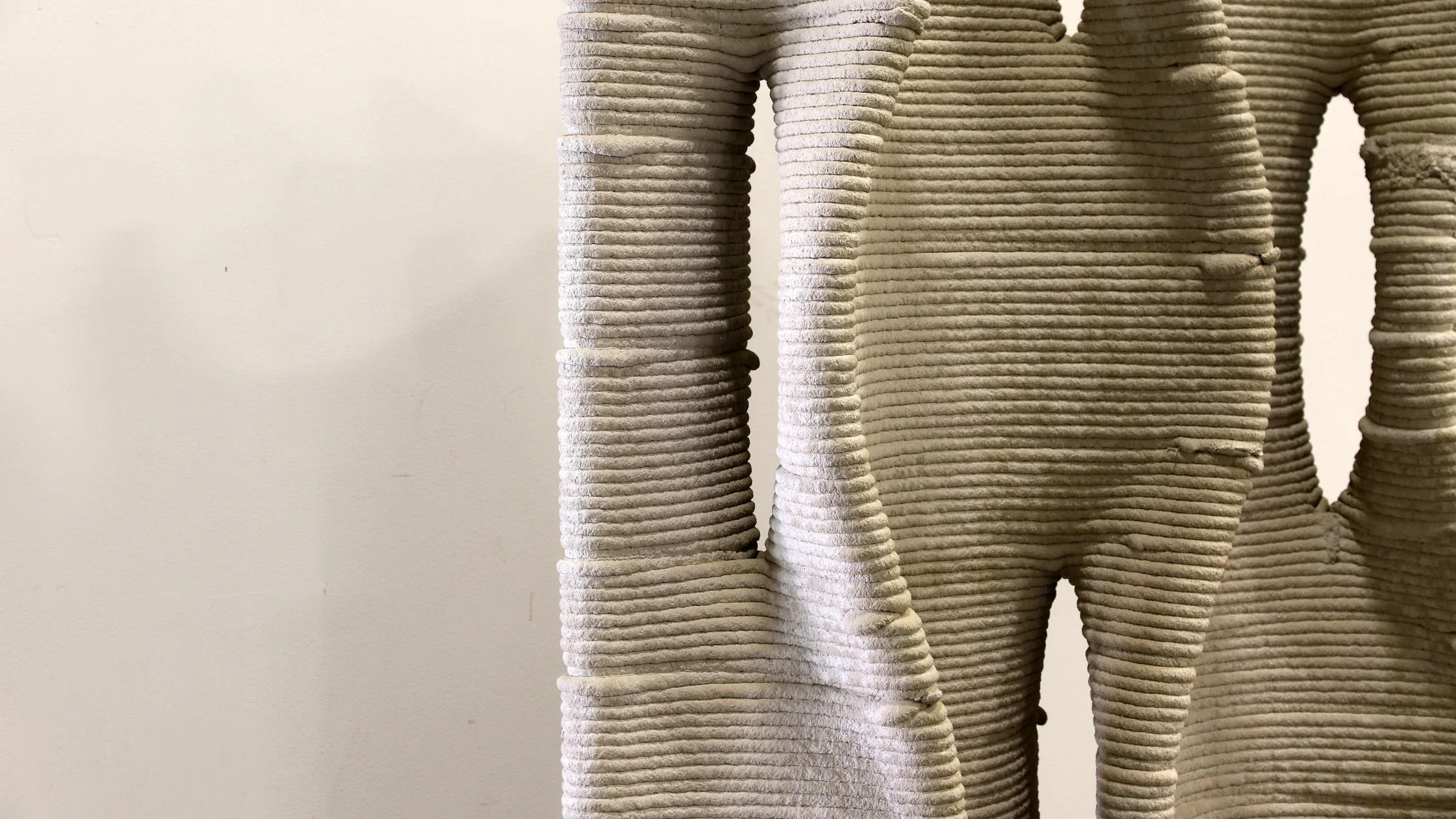
Printed models and assembly sequences compare force-informed print directions and component organization at model scale. View evidence ↓
Scaled fabrication models test how discrete concrete structures can be printed and assembled before committing to full-scale production. Each model reproduces the intended fabrication approach and layer organization, making toolpath choices visible in a physical object.
At a scale of 1:10, the components can be produced on desktop 3D printers with limited modification. Component tests, partial assemblies, and complete models reveal how printing direction, surface texture, and joint geometry affect the fabrication scheme.
A compression-dominant funicular floor provides the case study. Parallel, nonparallel, and creased slicing strategies are compared across its components, with print directions aligned to the principal stress paths.
The collaborative study by Yefan Zhi, Teng Teng, and Masoud Akbarzadeh was published in Architectural Intelligence in 2024.
Form finding and print direction
Graphic-statics geometry, force-informed printing directions, and alternative slicing strategies.
Model assembly
Partial assemblies and the completed scaled fabrication model.
Related publications
All publications →-
Designing 3D-printed concrete structures with scaled fabrication models
Architectural Intelligence · 2024