Working prototypes and an eight-participant study compare task completion. Results support sketch-level use within that small study, not a general robot-performance ranking. View evidence ↓
Prototypes and fabrication
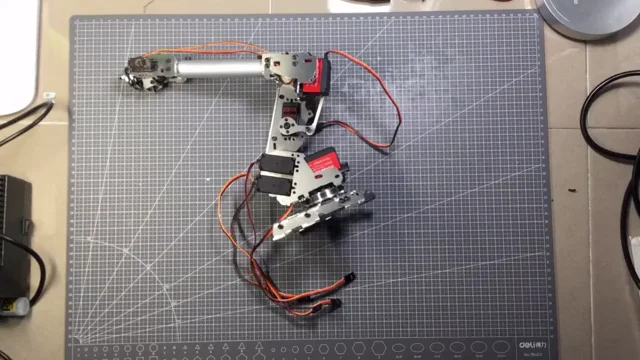
The assembled six-axis arm and controller (left), and hot-glue deposition with a replaceable end effector (right).
3D-printed parts, motors, and transmission components before assembly (left); PICA configured for hot-wire foam cutting (right).
What the study found
The CAADRIA paper reports a study with eight Cornell architecture students, divided by prior digital-fabrication experience. Each participant completed two 15-minute tasks: making a vase from an assigned reference using clay manipulation and PICA, and modeling another vase in Rhino for fabrication with an ABB IRB 4600. Completion was measured by the printed proportion of the vase: a fully printed vase scored 5, 80% completion scored 4, and so on.
| Fabrication workflow | Junior fabricators | Senior fabricators | Overall mean |
|---|---|---|---|
| PICA with direct manipulation | 4.75 | 4.00 | 4.375 |
| IRB 4600 with the conventional workflow | 2.00 | 3.00 | 2.50 |
The higher completion scores support PICA’s potential for rapid, sketch-level prototyping in this experiment. The comparison changed both the robot and the modeling workflow, so it does not isolate a hardware effect or establish a general productivity advantage. The project’s contribution is an integrated, affordable platform through which designers can build a robot, work directly with geometry, and test ideas through fabrication.
PICA is a personal robotic fabrication platform for making sketch-level architectural prototypes. It brings together a configurable six-axis arm, custom Grasshopper controls, and replaceable fabrication tools so that designers can move from a digital or hand-shaped idea to a physical working model.
I led the project at Cornell University’s Jenny Sabin Lab, developing its hardware and software. Published at CAADRIA 2020, the research asks how robotic fabrication can become affordable and accessible during early design, when forms are still changing and direct engagement with a model can help generate the next idea.
Testing two fabrication approaches
Hot-wire cutting translates surfaces modeled in Rhino/Grasshopper into the arm’s motion. A wire mounted on a custom end effector cuts foam blocks into a family of curved forms, testing the connection between surface geometry, tool orientation, and physical output.
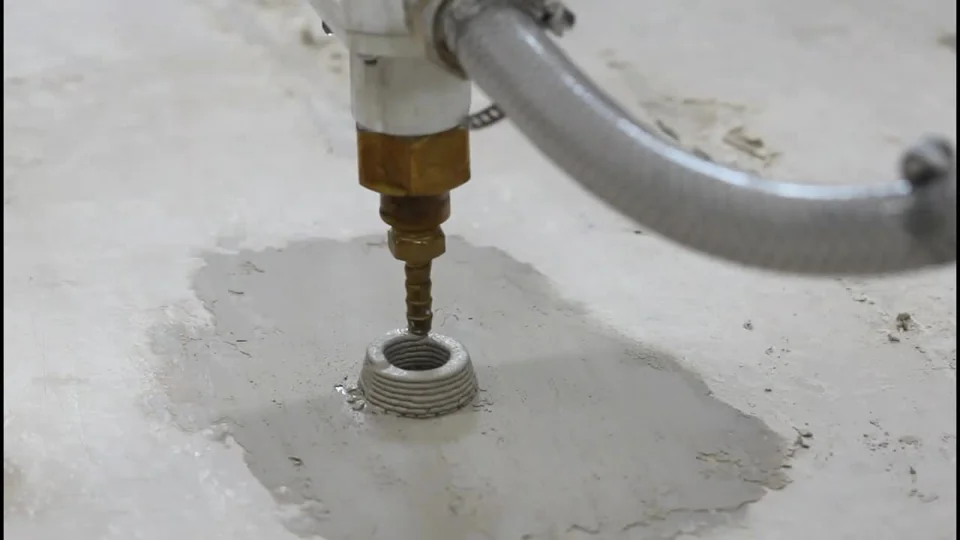
Interactive hot-glue deposition, the application examined in the paper, starts with a clay vase shaped by hand on a turntable. Two infrared depth scanners capture the changing form. Rhino/Grasshopper reconstructs the geometry and generates a surrounding toolpath, while PICA deposits a corresponding form using a modified glue gun and a motor-driven feed. The heated tool can also push or drag the deposited wall as the source shape changes. Material cooling and the relatively coarse glue feed limited precision; the aim was an adaptable working model during concept development.
Foam models produced by hot-wire cutting (left) and the corresponding surface geometry used to develop the fabrication paths (right).
Hand-shaped clay captured as a point cloud and reconstructed geometry (left), and examples of the resulting hot-glue vase prototypes (right).
A robot designers can build and adapt
PICA begins with a parametric joint–link model in Grasshopper. Link lengths define the robot’s configuration and working range; changing a segment allows a new part to be printed while updating the corresponding kinematic model. The platform combines a printed base, shoulder, arm, wrist, and interchangeable end effectors.
The project progressed from early servo-driven interaction prototypes to stepper-driven fabrication arms. The portfolio documents four hardware iterations. The fabrication configuration uses seven bipolar stepper motors across six axes, with NEMA 23, NEMA 17, and NEMA 14 motors selected according to joint loads. Timing-belt transmissions and geared reducers provide the required torque within a compact printed structure. The portfolio’s bill of materials totals US$748 at the time of the research, consistent with the paper’s reported cost of under US$800.
Exploded assembly with motor and transmission labels (left), and joint mechanisms showing the belt drives and axis arrangement (right).
The joint–link model and alternative arm lengths (left); the Arduino control circuit and motor-driver connections (right).
From geometry to joint motion
I developed custom Grasshopper components for both forward and inverse kinematics. Direct joint-angle inputs support positioning and motion tests. For fabrication, the inverse-kinematics component starts from an end effector’s position and orientation, checks reachability, and calculates joint angles using geometric analysis and Denavit–Hartenberg parameters. Candidate poses are filtered against the task constraints and a shortest-path criterion.
The resulting joint angles are converted into motor steps, accounting for transmission ratios. In the system documented in the paper, Grasshopper streams commands over UDP/Ethernet to an Arduino Mega, which drives the motors through stepper drivers. This keeps geometry, toolpaths, and robot control within the designer’s modeling environment and allows commands to change during fabrication without a separate robot-language programming stage.
Forward-kinematics control through individual joint angles (left) and inverse-kinematics control from a fabrication toolpath (right).
Grasshopper motion simulation (left) and a gesture-control demonstration from the project archive (right). Both are looping GIFs.
Physical motion test of the assembled arm (left, looping GIF) and the hot-wire end-effector design (right).
Publication
Teng, T. and Sabin, J. (2020). “PICA: A Designer Oriented Low-Cost Personal Robotic Fabrication Platform for Sketch Level Prototyping.” RE: Anthropocene — Proceedings of the 25th CAADRIA Conference, Volume 2, pp. 473–483.
Read the full paper · Publication record · Related robotics teaching project
Related publications
All publications →-
PICA - A Designer Oriented Low-Cost Personal Robotic Fabrication Platform for Sketch Level Prototyping
RE: Anthropocene, Design in the Age of Humans - Proceedings of the 25th CAADRIA Conference - Volume 2 · 2020